1. Product Overview
A demister pad (also called wire mesh mist eliminator, mesh pad or knitted mesh demister) is a high-efficiency gas–liquid separation element made of multiple layers of knitted wire mesh — stainless steel, PP, PTFE or exotic alloys — compressed into a pad of specific density and thickness. As the mist-laden gas flows through the mesh, entrained liquid droplets are captured by inertial impaction, coalesce on the filaments and fall back by gravity, achieving efficient gas–liquid separation.
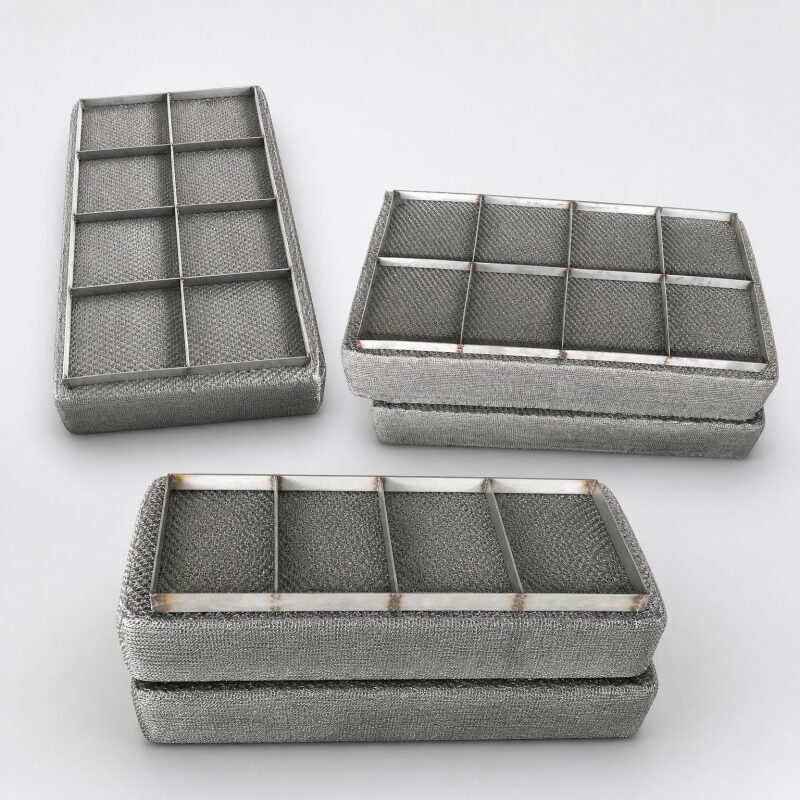
The pad is manufactured by stacking and pressing knitted wire mesh fabric to the required density and thickness, reinforced by high open-area support grids (metal or plastic frames) on both sides for rigidity under gas flow. Its key advantages are simple construction, low pressure drop and high separation efficiency, making it widely used in distillation, absorption, evaporation, desulfurization, oil–gas separation and many other gas–liquid separation duties.
2. Working Principle
The demister operates on the principles of inertial impaction and coalescence. As the mist-laden gas rises or flows horizontally through the mesh pad, the gas stream turns around the wire filaments, but the much denser liquid droplets cannot follow the streamlines. They strike the filaments by inertia, adhere to the wire surface, spread along the filaments and coalesce at the crossing points until the droplet weight overcomes the upward gas force and surface tension. The enlarged droplets then fall back by gravity, while the cleaned gas passes through.
Separation efficiency mainly depends on droplet size, wire diameter, specific surface area of the mesh, pad thickness and fluid properties. A standard specification pad (wire ø 0.28 mm, density 145 kg/m³, surface area 300 m²/m³) typically removes close to 100% of droplets of 5 μm and larger. For finer droplet removal, a high-surface-area mesh (500 m²/m³) made from 0.15 mm wire can be supplied.
3. Key Features
● Simple structure, lightweight; easy to install, dismantle and maintain
● High free volume (94.5% – 99.0%); low gas resistance and low pressure drop
● Large specific surface area and high separation efficiency — approx. 100% removal of droplets ≥ 5 μm
● Wide material selection, resistant to acid, alkali and corrosive media (stainless steel / duplex / Hastelloy / PP / PTFE, etc.)
● Stable operation and long service life under continuous duty
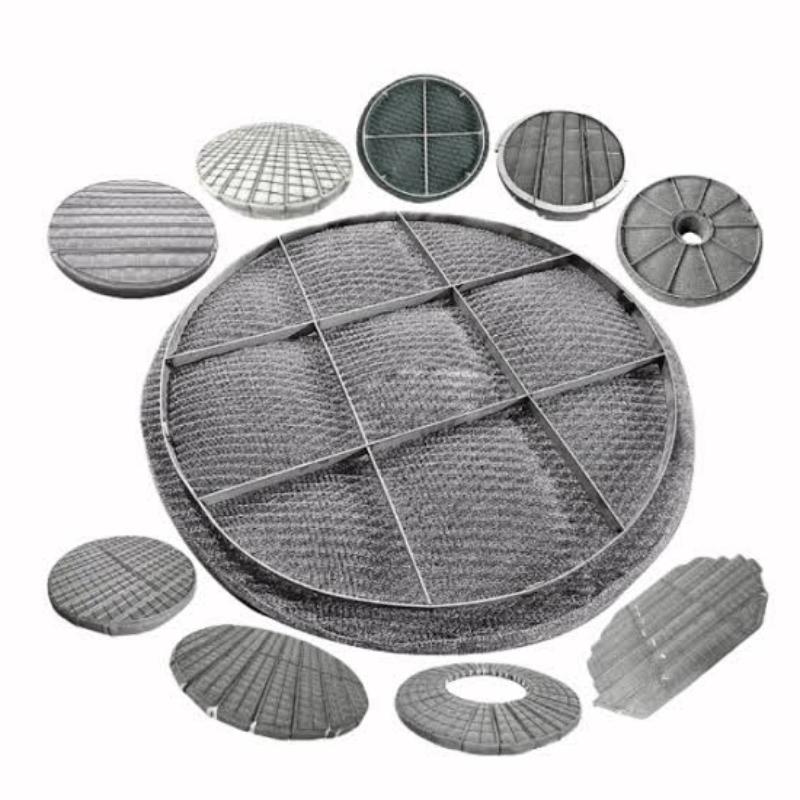
● Customizable in any shape and size: round, rectangular, annular and segmented construction
● Precisely controlled pressure drop; suitable for both vertical and horizontal gas flow arrangements
4. Product Types
By Appearance
● Standard (flat) type: for general gas flow duties, the most commonly used
● Wave (crimped) type: embossed surface for increased surface area and capture capacity
By Frame Material
● Metal frame: 304 / 316L, etc., high temperature resistance, for oil & gas and chemical plants
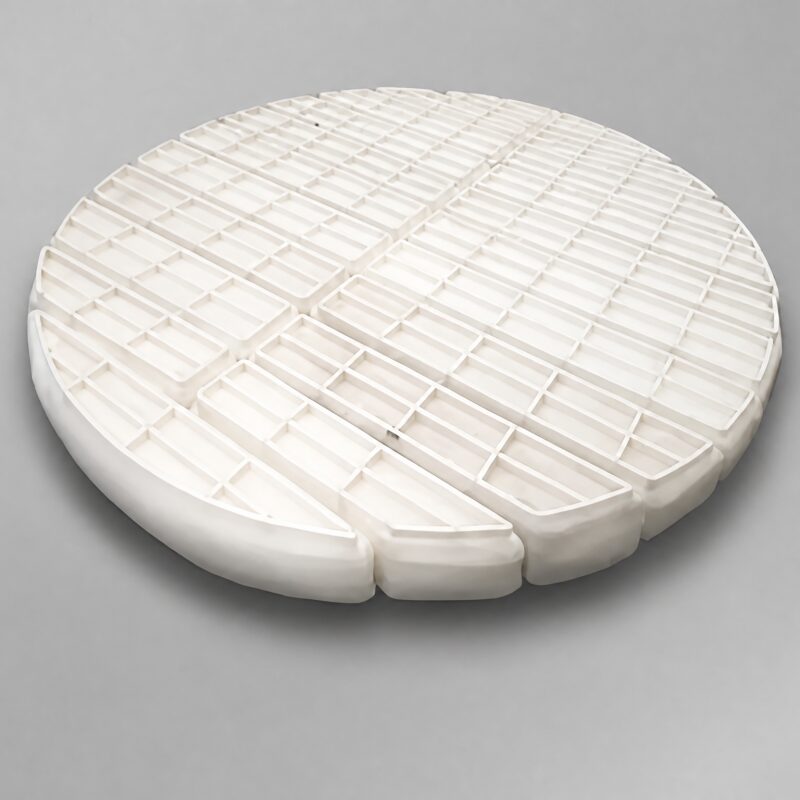
● PP frame: corrosion resistant and lightweight, for acid and alkaline media
By Construction
● One-piece type: small sizes formed as a single unit
● Joint (segmented) type: diameters > 500 mm supplied in segments, each 300 – 400 mm wide
By Shape
● Round (disc), rectangular, annular and custom shapes per drawing
5. Technical Specifications
5.1 Standard Metal Mesh Series
| Style |
Density kg/m³ |
Free Volume % |
Surface Area m²/m³ |
Common Equivalent Styles |
| H |
80 |
99.0 |
158 |
York 931 / ACS 7CA / Hi-Throughput |
| L |
120 |
98.5 |
210 |
York 422 |
| N |
144 |
98.2 |
280 |
York 431 / Knitmesh 9030 / ACS 4CA / Nu-Standard |
| SN |
128 |
98.4 |
460 |
York 326 / Knitmesh 415 |
| SL |
193 |
97.5 |
375 |
York 421 / ACS 4BA / Knitmesh 9033 / Xtra-Dense |
| SM |
300 |
96.2 |
575 |
High-Density |
| SH |
390 |
95.0 |
750 |
Super-High-Density |
| T |
220 |
97.2 |
905 |
Extra-Dense Multi-Strand |
| W |
220 |
97.2 |
428 |
Wound Type |
| R |
432 |
94.5 |
1780 |
York 333 / Multi-Strand |
| GS |
160 |
96.7 |
5000 |
York 371 / Extra-High Surface Area |
Note: The 80 kg/m³ style suits both metal and plastic materials; other styles are normally metal only. Equivalents reference common industry series (Metex / York / Knitmesh / ACS, etc.); final supply is subject to the confirmed specification sheet.
5.2 Typical Process Parameters
| Parameter |
Typical Value |
| Common wire diameter |
0.15 – 0.28 mm (standard 0.20 / 0.25 / 0.28 mm; fine type 0.15 mm) |
| Standard density |
80 – 160 kg/m³ (common 100 / 145 kg/m³; customizable up to 432 kg/m³) |
| Free volume (void fraction) |
94.5% – 99.0% |
| Specific surface area |
158 – 5,000 m²/m³ (standard approx. 280 – 300 m²/m³; high-efficiency 500 m²/m³) |
| Removal efficiency |
Approx. 100% for droplets ≥ 5 μm; high-efficiency capture of 3 – 5 μm droplets (standard type) |
| Allowable gas velocity factor (Souders–Brown) |
0.35 ft/s vertical flow; 0.42 ft/s horizontal flow (air–water system, ambient conditions) |
| Standard thickness |
100 / 150 / 200 mm (common: 150 mm pad + 2 × 25 mm support grids = 200 mm total) |
| Layers |
Approx. 25 layers per 100 mm pad thickness |
| Operating temperature (reference) |
Stainless steel type ≤ approx. 400°C; PP type ≤ approx. 90°C; PTFE type ≤ approx. 250°C (confirm per material and service) |
5.3 Available Materials
| Category |
Materials |
| Stainless steel |
304 / 304L / 316 / 316L / 316Ti / 321 / 310S / 410 |
| Duplex / high-alloy |
2205 (S31803), 2507 (S32750), Alloy 20, 904L, Hastelloy C-276, Monel 400, Inconel 600/625, Titanium |
| Plastic |
PP (Polypropylene), PTFE (Polytetrafluoroethylene), PVDF, Nylon (Dacron) |
| Others |
Carbon steel, galvanized steel, brass / copper, fiberglass |
5.4 Common Dimensions
| Item |
Specification |
| Round pad diameter |
Ø300 – 5,200 mm (top-load type); Ø700 – 4,600 mm (bottom-load type) |
| Large-diameter segmentation |
Diameter > 500 mm: supplied in segments, each 300 – 400 mm wide |
| Standard thickness |
100 / 150 / 200 mm |
| Shape |
Round, rectangular, annular, or custom per drawing |
| Mesh roll width |
Standard 1,000 / 1,500 mm (slitting available on request) |
5.5 PP Demister Pad (Plastic Type)
| Item |
Specification |
| Material |
Polypropylene (PP) monofilament |
| Wire diameter |
0.20 / 0.22 / 0.23 / 0.25 / 0.28 / 0.30 / 0.35 mm |
| Mesh opening |
2 × 3 mm, 4 × 6 mm up to 12 × 6 mm (customizable) |
| Type |
Standard / Wave type; PP frame / metal frame; one-piece / joint type |
| Application |
Acid, alkaline and corrosive media; corrosion resistant and lightweight |
Note: The above data are industry-standard reference values compiled from public information of major manufacturers; the final supply is subject to the technical agreement and drawings.
6. Applications
Chemical Industry
● Gas–liquid separation in distillation columns, absorbers, strippers, evaporators and dryers
● Removal of entrained droplets and mist in catalysis, distillation, evaporation and absorption processes
Oil & Gas / Refining
● Crude oil dehydration, crude degassing, overhead systems of atmospheric/vacuum columns and tower internals
● FCC units, hydrogenation units, desulfurization towers, gas–liquid separators and coalescers
Environmental Protection & Water Treatment
● Flue gas desulfurization (FGD), exhaust gas demisting, acid mist purification towers
● Wastewater treatment, air purification, dust scrubbers
Other Industries
● Pharmaceutical: evaporation concentration, spray drying, fermentation off-gas treatment
● Light industry, food, power, marine, air separation, LNG, aerospace and other mist elimination duties
7. Installation
● Depending on the vessel opening position, two installation types are available:
● Top-load type: selected when the opening is above the demister or a flange is located above; diameter range Ø300 – 5,200 mm
● Bottom-load type: selected when the opening is below the demister; diameter range Ø700 – 4,600 mm
● The pad is sandwiched between 25 mm thick support grids, fixed with tie rods and installed on the tower support ring or vessel flange. It can be arranged horizontally or vertically.
8. Packaging & Ordering Information
Packaging
● Standard packaging: wooden case / wooden frame with moisture-proof lining to prevent deformation in transit
● Custom packaging available (pallets, export heat-treated wooden cases, etc.)
Information Required for Ordering
● Material (e.g. 316L, PP, 2205, etc.)
● Dimensions: diameter or length × width × thickness (e.g. Ø800 × 150 mm)
● Density / style requirement (or let us recommend based on the standard series)
● Quantity, installation type (top-load / bottom-load) and drawing requirements
9. Selection Notes
● Higher density and larger surface area improve separation efficiency but increase pressure drop and reduce the allowable gas velocity — balance efficiency against energy cost
● Horizontal flow arrangement offers approx. 30% higher capacity than vertical flow, allowing a more compact vessel for the same throughput
● For fine-droplet duties, a 0.15 mm wire with 500 m²/m³ high-surface-area construction is recommended
● For corrosive media, prefer 316L, duplex 2205/2507, Hastelloy, or PP / PTFE materials
● For high-temperature service, use metal materials and confirm the temperature rating of both mesh and frame; for low-temperature / high-cleanliness duties, consider PP or PTFE
— Compiled by Anping County Bolin Metal Wire Mesh Co., Ltd. for reference only; final specifications and quotations to be confirmed with our sales team. —